When you’re a buyer of translation services and don’t speak the target language, it can be very difficult, if not impossible to judge the quality of the translation provided to you. However, by calling on an experienced translator with the credentials to prove it, you’re guaranteed to get the quality content you’re looking for.
When it comes to even the shortest of texts, ensuring that a professional translator either does the translation themselves or reviews your own translation is critical. While you may be tempted to cut costs by relying on your most bilingual employee to translate content instead of hiring a professional translator, you may be setting yourself up for disaster. The devil is in the details, and even the smallest error can ruin a translation. A translator who translates into their mother tongue is the only person who should be putting a stamp of approval on all of your translated content.
Take the example of slogans. It takes hours, if not days or month, for companies to come up with a slogan. Translating a slogan doesn’t require quite as much time, but it is just as important to analyze its message, how it makes the company stand out from competitors, and make it memorable, in order to make it effective in the foreign language. If all of that is not done and the translation is more or less literal, chances are that it will not communicate the same message and sound stilted and awkward.
A non-bilingual might not even notice if a translation doesn’t work. For example, unless you know a small amount of French, would you understand the translation below?

In addition to the incorrect spelling of “alcohol,” could you even guess what “stranger wine” is? What if I told you that “étranger” in French can be translated as either “foreign” or “stranger” in English? Without knowing French and English well enough, by opting for the latter, the result is a nonsensical translation.
Words are a product of culture, where a single word can carry more meaning depending on its importance to that culture and, consequently, have multiple translations in other languages. To state the obvious, this is why you cannot translate word-for-word.
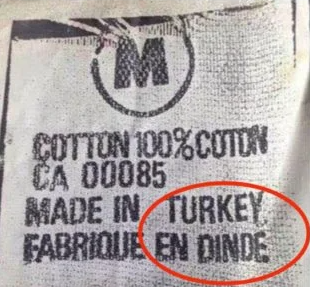
In the example below, the English is fine. But what about the French? What if I told you that “dinde” is what you eat on Thanksgiving and not the country, which would be “Turquie”?
Lastly, prepositions and connector words are perhaps the smallest yet most difficult words to translate. In English, there’s a joke that goes: “I hate it when people use the wrong preposition on a sentence.” However, it’s an all-too-common mistake when people translate into their non-native language: a small mistranslation, but one that sticks out like a sore thumb.
As I explain in this article on the importance of translating into your maternal language, even if you need just a few words or a single sentence translated, relying on the services of a professional translator is essential to ensuring that you receive an impeccable translation. Your translated content must be as accurate and culturally appropriate as possible, and a speaker of the foreign language is in the best position to evaluate whether or not the translation works.
When you’re a buyer of translation services and don’t speak the target language, it can be very difficult, if not impossible to judge the quality of the translation provided to you. However, by calling on an experienced translator with the credentials to prove it, you’re guaranteed to get the quality content you’re looking for.

You may also be interested in these blog posts ...

Promoting Sustainable Building Through Translation
Green building and materials certifications are on the rise as the demand for greener products continues to increase. When it comes to translation, this means that knowing the steps in the certification process and the related terminology is critical in helping clients obtain the certifications they’re seeking.

Top Ten Reasons Why Experience Matters in Translation
Over the years, I have learned that translation is no exception to Malcolm Gladwell’s rule in his 2008 book Outliers: The Story of Success: it takes 10,000 hours of intensive practice to achieve mastery of complex skills. There is much more to being a translator than simply knowing two languages fluently.

The Word+Style Brand Story
Word+Style celebrated 10 years in business in 2022. Read about how Natalie Pavey grew her company over a decade, transitioning from working as a freelance translator to providing comprehensive French-English translation services to an array of clients across the world.