
Ever been tempted to draft a translation using a translation engine such as Google Translate or DeepL? Let’s break down why that’s not a good idea if you want a text that resonates with your target audience.
If you’ve ever used a service known as “machine translation post-editing (MTPE),” you might be surprised to learn that, although it speeds up the translation process, it is the most surefire way to downgrade translation quality.
MTPE is a service offered by some translation agencies and translators that involves reviewing and editing machine-generated translations. In other words, a text is run through a translation engine such as Google Translate or DeepL, which spits out a rough draft, and the translation is then sent to a human translator for editing. When neural machine translation (NMT) appeared as a breakthrough technology in the mid 2010s, translation agencies began to offer MTPE as a way to speed up workflows and reduce costs for their clients. With the advent of large language models (LLMs) such as ChatGPT and Claude and, to the chagrin of many translators, MTPE has continually gained ground.
Many claim that MTPE is effective when dealing with large volumes of text that need “quick turnaround” and where style and precision are not top priorities. As mentioned in this study, machine translation tools “commonly meet the demand for translation coming from internet users who value speed, cost, and convenience over quality and who do not think professional translation services are necessary.”[1] So is it really worth sacrificing quality for speed? Is everything that urgent these days?
As a case in point, some translation agencies and translators even distinguish between “light post-editing (LPE)” and “full post-editing (FPE).” In their view, LPE focuses solely on comprehensibility, fixing critical errors to make the text understandable, while FPE ensures the text is accurate, coherent, and stylistically appropriate, claiming it to be indistinguishable from human translation. While it is debatable that FPE is as high quality as a human translation, it is safe to say that if you really want a subpar translation, you can just ask for LPE.
To argue that FPE is also lower quality than a “human-first” translation, you could say that MTPE is similar to using AI to draft a text. When you prompt an AI agent to create a text or generate ideas, you are not creating original content. AI is simply regurgitating concepts and points of view that it gleans from existing texts. In the same way, a translator who uses NMT or an LLM to make a first pass at translating a sentence or passage is simply regurgitating past translations, and is not creating anything original. The translation, as a result, comes out flat, even though it may be accurate.
This is not to say that NMT and LLMs have no place in the translation process. Studies such as this one[2] and this one[3] evaluate the quality of translation between artificial intelligence translation and human translations and show that the highest quality translation is produced when a translator interacts with translation tools to refine their translation. This is because the translator is generally more engrossed in the translation process as they translate sentence by sentence or paragraph by paragraph, sometimes looking ahead in the text as they translate to gain clarity and get more context. Conversely, with MTPE, a translator must “look behind” in the translation to ensure that translations are consistent, but can they say with certainty that the proposed translation was the best translation from the start? It is not a given, especially when under time constraints.
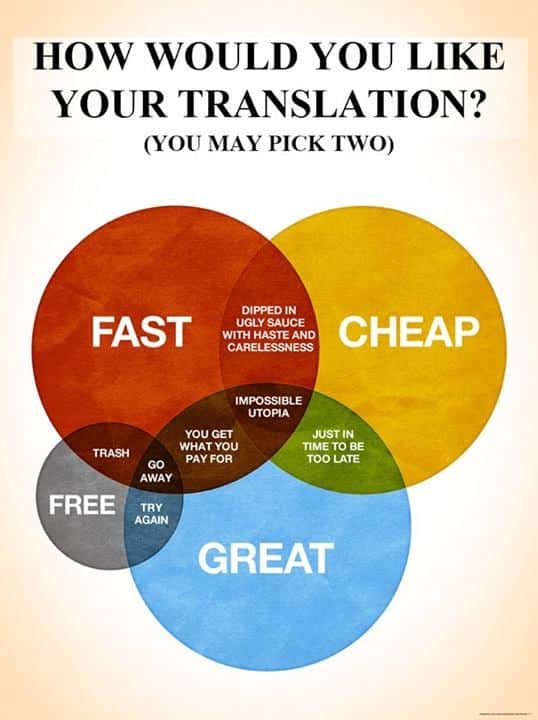
As the classic Venn diagram shows, if you want it fast and cheap, you’ll sacrifice quality. Giving translators more time and the freedom to translate from scratch ensures that you’ll get a translation that is not only accurate, but also original.
[1] Moneus, Ahmed Mohammed and Yousef Sahari, “Artificial intelligence and human translation: A contrastive study based on legal texts,” Heliyon, Vol. 10, Issue 6e28106 (2024), https://www.cell.com/heliyon/fulltext/S2405-8440(24)04137-9, Accessed Jan 30, 2026.
[2] Fu, Lingling and Lei Liu, “What are the differences? A comparative study of generative artificial intelligence translation and human translation of scientific texts,” Humanities and Social Sciences Communication, 11, 1236 (2024), https://www.nature.com/articles/s41599-024-03726-7, Accessed Jan 30, 2026.
[3] Shahmerdanova, Roya, “Artificial Intelligence in Translation: Challenges and Opportunities,” Acta Globalis Humanitatis et Linguarum, Vol. 2, No. 1 (2025), https://egarp.lt/index.php/aghel/article/view/105, Accessed Jan 30, 2026

You may also be interested in these blog posts ...

Bilingualism in New Brunswick: The role of translation in a bilingual province
In New Brunswick, translation is often viewed as a burden. Here is why it should instead be seen as key to accessing opportunities and promoting economic growth.

The Cost of Translation
As with any product or service, there is a range in quality when it comes to translation that generally corresponds to its price. Here is everything that needs to be taken into account when considering how much translation services cost.

The Funny Thing About Translation Quality
Buyers of translation services count on translators to render their content faithfully in another language. But there is a hiccup: most clients are unable to judge the quality of the translations they receive. Here’s how you can be sure that you are getting quality service.