
Les Éditions Passe-Temps – Educational Games
Les Éditions Passe-Temps is a Canadian publisher based in Quebec City that specializes in
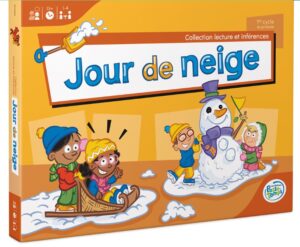
“Jour de neige” [Snow Day] game from the L.I.R.E. collection, designed for children in grades 1 and 2.
The Problem
As the game series is generally aimed at students at all elementary school levels, each game can have several levels of difficulty. Consequently, we needed to ensure that grammar and spelling in English were at the learning level of the target ages.
In addition to translating and adapting sentences designed for varying levels of difficulty, we also needed to ensure consistency between the different components of the games in the series. This concerned, for example, the rules of the game and game instructions.
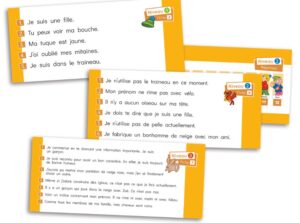
Clue cards included in the game with examples of sentences to translate.
Finally, the name of the game collection being L.I.R.E. (Lis. Infère. Relis. Examine.) in French, ideally, we had to find an equivalent word in English (R.E.A.D.), but an acronym using four specific verbs in a language will rarely give the same letters after translation. One possibility was to translate the collection as the “Learn to Read collection”, but was it possible to find verbs that fit the context to keep the acronym R.E.A.D. and have the same impact?
The Solution
First, we formed a translator-reviser team who knew the nuances of Canadian English. This team had already worked for the client on promotional materials and was therefore familiar with their products.
Secondly, the translator and the reviser had to be sensitive to the nuances of the language level. For example, for games intended for grades 1 and 2, we decided not to use contractions in English so as not to make sentences too complex.
After validating the translation of the first game in the series, we were able to rely on a translation memory and a lexicon that included the previous translations. As we translated the increasingly complex sentences, we also adapted their English translations to ensure that sentence structures became more and more difficult.
Next, we brainstormed the acronym L.I.R.E. which resulted in a list of seven proposals for consideration by the client, in addition to a list of possible verbs to use in the acronym.
As a last step, the client produced mock-ups of the translated games, which we proofread to make sure they were free of typos and layout issues.
The Outcome
As Canada has a majority of English speakers, an English version of the games makes it possible to reach a much larger market, including schools, libraries, community organizations and families outside Quebec, and even internationally.
The translation and adaptation process also adjusted cultural references, examples or instructions to better resonate with various Canadian contexts, improving pedagogical effectiveness.
As for the acronym L.I.R.E., we managed to find an English equivalent that conveyed the same concepts: R.E.A.D.: Read. Examine. Analyze. Deduce. Although the verbs are not literal translations, the sequence of verbs in English communicates steps in the reading process that result in understanding similar to the French version.
Lastly, translating a product name into another language also improves cultural acceptability with the target audience and strengthens marketing positioning to facilitate entry into new markets.
It is always a pleasure collaborating with Natalie on the translation of various educational games and tools. She is rigorous, organized and flexible when necessary. The process is always simple and enjoyable! I have complete trust in her.
~ Catherine Nicole, Publishing Coordinator, Les Éditions Passe-Temps